
27 Jun, 2026
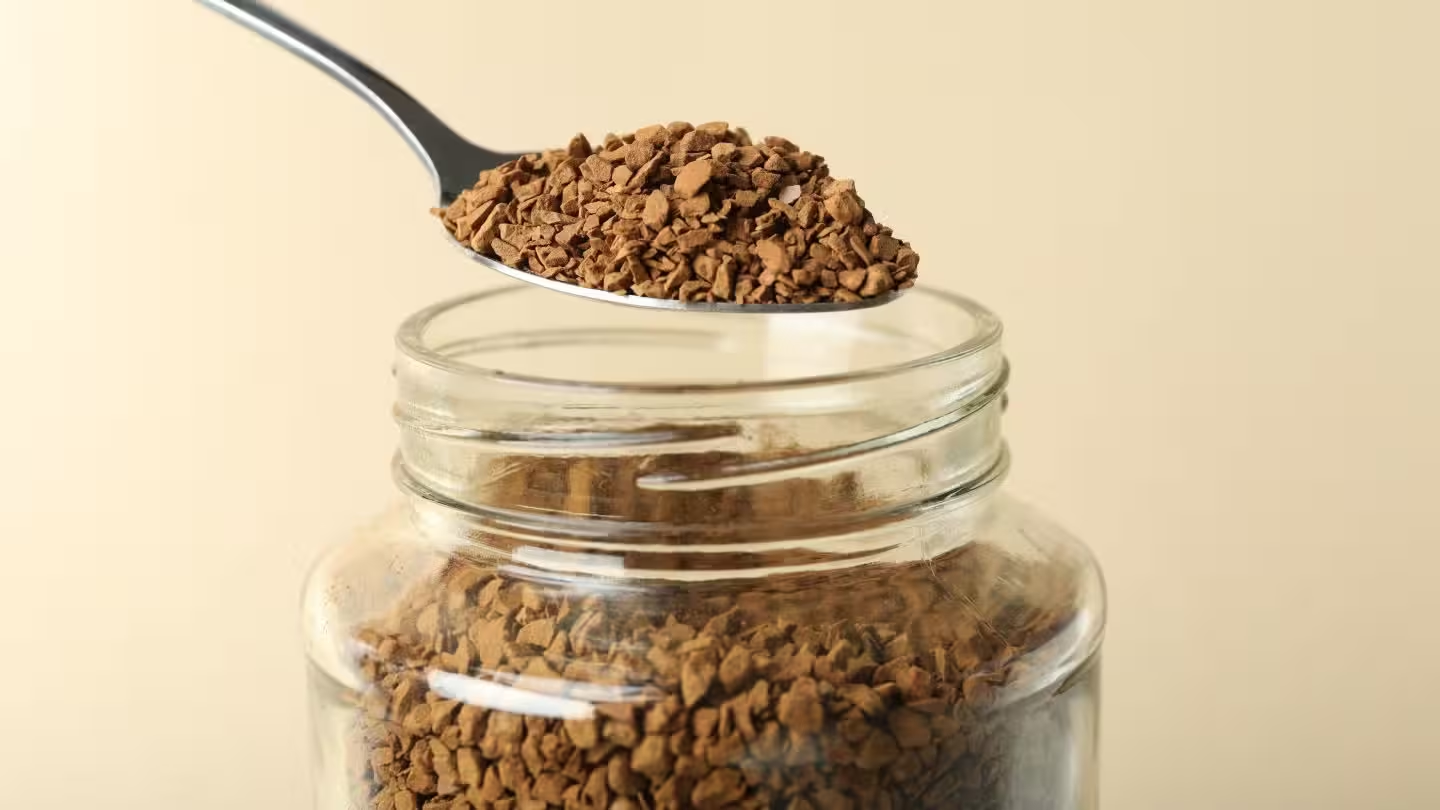
Instant coffee sits in one of the least straightforward areas of EUDR planning. Coffee is clearly one of the commodities covered by the EU Deforestation Regulation. Many coffee-derived products are already treated as relevant products. Finished instant coffee, soluble coffee, and coffee mixes, however, raise a narrower and more practical question: is the exact CN or HS code for this product currently listed in EUDR Annex I?
That classification detail matters. A container of green coffee entering the EU is not the same compliance case as a jar of freeze-dried coffee, a bulk carton of spray-dried powder, or a 3-in-1 sachet manufactured outside the EU. The coffee may originate from the same farms, but customs classification, processing records, and due diligence workflows can diverge quickly once beans are roasted, extracted, dried, blended, and packed.
The working answer for buyers and suppliers is this: treat instant coffee as a compliance-risk category, even if a particular finished product code is not clearly triggering full EUDR checks today. Product scope can change through Annex I updates or delegated acts. EU buyers may also ask for EUDR-style evidence before every instant coffee SKU is formally treated in the same way as green or roasted coffee.

EUDR requires covered commodities and relevant products to be deforestation-free, legally produced, traceable to origin, and supported by due diligence before they are placed on the EU market or exported from it.
For coffee, the key land-use date is 31 December 2020. If a coffee product is in scope, the coffee must not come from land deforested after that date. It must also comply with relevant laws in the country of production, including land-use rules, environmental obligations, labour rules, tax requirements, and human rights-related requirements where they apply.
The question is not “is coffee covered?” Coffee is covered. The better question is whether the specific finished instant coffee product code is listed as a relevant product at the time of shipment.
Large and medium companies should plan around 30 December 2026, while micro and small operators should monitor 30 June 2027. Because the EUDR timeline and product scope have been adjusted before, companies should confirm the latest official EU and customs guidance before making shipment, contract, or labelling decisions.
Why The Answer Depends On Product Codes
EUDR does not automatically apply to every product that tastes like coffee or contains a coffee-derived ingredient. It applies to listed commodities and listed relevant products. That means procurement, customs, and compliance teams need to check the product code, composition, processing country, and current Annex I status.
| Product type | Practical EUDR position |
|---|---|
| Green coffee | Central coffee compliance category |
| Roasted coffee | Commonly treated as a covered coffee product where listed |
| Decaffeinated coffee | Needs code review, but often discussed within covered coffee forms |
| Coffee extracts and concentrates | Important to check because processed coffee forms may be listed |
| Coffee oils | Requires product-code review |
| Instant or soluble coffee | Grey-area or changing-scope category that needs verification |
| 3-in-1 coffee mixes | Requires customs-code, ingredient, and origin review |
| Flavoured instant coffee | Requires coffee-origin, ingredient, food safety, and labelling review |
Do not treat “instant coffee” as one fixed legal category. A 100% freeze-dried granule, a cappuccino instant mix, and a sweetened 3-in-1 sachet may not land in the same compliance position.
Instant coffee is still made from coffee. The typical process starts with green coffee and moves through roasting, extraction, concentration, drying, blending, and packing. The finished product may be sold as powder, granules, sachets, jars, sticks, or bulk foodservice packs.
The grey area appears because the coffee has changed form before it crosses the EU border. If green coffee enters the EU first and is processed inside the EU, the importer is dealing with a clearer coffee commodity case. If finished instant coffee is manufactured outside the EU and imported as a packaged product, it may arrive under a different code and a different border workflow.
This creates a regulatory design risk. If finished instant coffee remains outside scope while green, roasted, decaffeinated coffee, extracts, concentrates, mixtures, or oils are covered, a company could theoretically move more processing outside the EU and import a finished product with less EUDR scrutiny. That does not mean every instant coffee supplier is trying to avoid the rules. It means buyers should avoid building sourcing plans around a gap that may close.
The operational problem is even bigger than the legal one. Soluble coffee factories often blend coffee from multiple farms, cooperatives, exporters, or origins. Once those lots are roasted, extracted, dried, mixed with sugar or creamer, and packed into retail units, the origin trail can become harder to prove unless the factory has built batch-level traceability from the start.

Even where a particular instant coffee SKU is not clearly in scope today, the core EUDR evidence categories still matter. EU retailers, importers, wholesalers, and private-label buyers may ask for them during supplier approval. Future scope changes could also make the same evidence mandatory.
Deforestation-Free Proof
For covered coffee products, the source coffee must be tied to land that was not deforested after 31 December 2020. In an instant coffee supply chain, the main challenge is not simply collecting that farm-level evidence. It is connecting the evidence to the finished batch.
A statement such as “Vietnamese Robusta” or “Brazilian Arabica” is too broad for a strong compliance file. Buyers may need source lot IDs, harvest periods, cooperative or farm links, supplier declarations, and proof that verified lots were not mixed with unknown-origin coffee during processing. If the same extraction batch feeds several retail SKUs, the traceability record should show that connection clearly.
Legal Production Evidence
EUDR is not only about forest loss. Coffee must also be legally produced in the country of origin. Depending on the country, buyer, and risk profile, this may include land-use records, farmer or cooperative registrations, environmental documentation, labour-related evidence, tax documents, and supplier declarations.
For instant coffee exporters, this evidence should not stay only with the green coffee trader. It needs to follow the coffee into the soluble coffee factory. If a buyer asks which source lots were used in a specific cappuccino mix or 3-in-1 production run, the supplier should be able to trace back from finished lot code to input coffee lots and then to the available legality evidence.
Geolocation And Batch Traceability
Covered coffee lots need a link back to production plots. Smaller plots may use GPS points, while larger plots may require polygons. In practice, farm mapping files can contain wrong coordinates, overlapping boundaries, missing plots, duplicate producers, or outdated paper records. These errors should be caught before the coffee is processed into an irreversible blended batch.
Instant coffee adds another layer. A good traceability file connects incoming coffee lots to roasting, extraction, concentration, drying, blending, packing, storage, and export shipment records. If verified and unverified lots are mixed without controls, one weak input can put the whole finished batch under buyer scrutiny.
DDS Readiness For Processed Coffee
A Due Diligence Statement, or DDS, is the EUDR submission or reference trail used for covered products. Operators must collect information, assess risk, mitigate any non-negligible risk, and submit or retain DDS data depending on their role.
For instant coffee, DDS readiness means having the data in a form that can be used if the product becomes clearly covered. That includes product description, quantity, origin data, geolocation links, legality evidence, risk checks, mitigation notes, and references to supplier DDS numbers where available. Waiting until a buyer asks for this at shipment stage is risky, because the missing information may sit several steps upstream.
Responsibilities depend on the role in the transaction. A non-EU supplier may not submit the EU DDS directly, but the EU buyer will still depend on that supplier for origin and processing evidence.
| Actor | Practical responsibility |
|---|---|
| EU importer or first placer | Holds the strongest documentation burden for covered goods, including product data, origin evidence, risk assessment, and DDS workflow |
| Non-EU instant coffee exporter | Provides origin, geolocation, legality, processing, batch-link, and export documentation to EU buyers |
| Soluble coffee manufacturer | Preserves traceability from incoming coffee lots through extraction, drying, blending, packing, and finished lot codes |
| Private-label brand or retailer | Sets supplier requirements and asks for EUDR readiness evidence, even where finished-product scope is uncertain |
| Wholesaler or downstream trader | Keeps supplier/customer records, DDS references where relevant, and supporting documents for covered products |
The strongest suppliers will not answer EUDR questions only with certificates or marketing claims. They will show how the coffee moved through the production system and where each claim is documented.
Before sourcing, importing, or producing instant coffee for the EU market, build a practical evidence pack. It does not need to be overcomplicated, but it should be specific enough to survive buyer review.
Start with product and customs data. Record the CN or HS code used for the product, the product description, the format, the quantity, the net weight, the lot code, and the production date. The file should also identify the country of coffee production, the country of processing, the manufacturer, the exporter, the importer, and the brand owner. For mixes, flavoured products, and cappuccino-style drinks, keep the ingredient composition with the same discipline as the customs information.
Then move to origin and batch records. The useful file shows which source coffee lots were used in the finished product, which exporter, cooperative, mill, trader, or farm links are available, and which harvest period or origin region applies. Internal production records should connect incoming coffee to the finished instant product. Where verified and unverified coffee are handled in the same facility, segregation records become especially important.
Farm mapping and legality files are the next layer. Keep GPS coordinates or polygons where they are available, along with checks for overlapping plots, missing plots, or wrong coordinates. Land-use or producer records, supplier declarations on legal production, and relevant environmental, labour, tax, or human rights-related documents should be attached where the buyer or risk profile requires them.
Finally, document the risk controls. This includes deforestation screening against the 31 December 2020 cutoff, satellite or forest-map checks where used, notes on high-risk or unclear lots, and mitigation actions such as additional verification or batch exclusion. If DDS references or supplier DDS numbers are available, keep them in the file. If they are not yet available because the product’s scope is uncertain, record how the supplier would provide them if the scope changes.

If Annex I is updated or instant coffee codes become clearly covered, border checks could extend to finished soluble coffee products. EU buyers would likely ask suppliers for farm-level traceability and DDS-compatible data before confirming orders, not after goods are produced.
Suppliers with batch-linking already in place would have an advantage. They could show how source coffee lots connect to extract batches, powder batches, blends, sachets, jars, cartons, and export shipments. Suppliers relying only on finished-goods invoices and country-of-origin statements would have more work to do.
Contracts may also need updates. Buyers may require EUDR evidence as a condition of purchase, the right to reject unverified lots, clearer responsibilities for data errors, and agreed timelines for document delivery. ERP systems may need new fields for source lot IDs, geolocation references, risk status, DDS references, and segregation status.
The safest assumption is that today’s ambiguity may not last. Build a system that can answer buyer questions now and adapt if formal scope expands.
Start with product classification. List every SKU that contains coffee and group it by format: soluble coffee, freeze-dried coffee, spray-dried coffee, extracts, concentrates, cappuccino mixes, 3-in-1 products, flavoured instant drinks, and other coffee-derived goods. Then check each product code against the latest official scope.
Next, map your coffee inputs. Identify which suppliers already provide EUDR-ready origin data, which lots have farm mapping, which suppliers can provide legality documents, and which inputs are only traceable to a trader or country level.
From there, build batch linking. The goal is to connect source coffee lots to each processing step: roasting, extraction, concentration, drying, blending, packing, and export. This is especially important for mixed products. A 3-in-1 sachet may look simple to the consumer, but the compliance file needs to separate coffee evidence from sugar, creamer, flavouring, packaging, and labelling records.
Where possible, keep verified coffee separate from unverified coffee. If that is not feasible, record the mixing rules clearly. One unclear origin can affect a much larger batch if there is no segregation or mass-balance logic the buyer accepts.
Finally, create a monitoring routine. Assign someone to watch official EUDR scope updates, customs-code interpretation, buyer requirements, and deadline changes. Do not leave this only to the logistics team at shipment time.
EUDR compliance does not replace food safety compliance. Instant coffee suppliers still need to consider contaminants, pesticide residues, extraction solvents where relevant, packaging safety, storage, moisture control, and labelling.
Ochratoxin A, often shortened to OTA, is a common coffee safety concern. Instant coffee also needs careful control of drying, storage, and packaging conditions because moisture, contamination, or poor handling can create quality and safety problems. For mixes, the compliance picture gets wider. A 3-in-1 product may introduce dairy ingredients, allergens, nutrition labelling, sweeteners, flavourings, and packaging-contact requirements.
This is why supplier approval should not ask only, “Are you EUDR ready?” A stronger question is: “Can you provide a complete EU market-access file for this exact instant coffee product?”
Is instant coffee definitely covered by EUDR?
Not always in a simple yes-or-no way. Coffee is covered, but the status of a finished instant coffee product depends on the exact product code and current Annex I scope. Verify the latest official guidance before shipment.
What is the main EUDR cutoff date for coffee?
The key deforestation-free cutoff is 31 December 2020. Covered coffee must not come from land deforested after that date.
Do non-EU instant coffee suppliers need EUDR documents?
They may not submit the EU DDS themselves, but EU buyers will often need their data. That can include origin records, geolocation evidence, legality documents, processing records, and batch links.
Are certificates enough for EUDR?
Certificates may support a file, but they do not replace mandatory due diligence for covered products. Buyers usually need traceable, product-specific evidence.
If you are comparing wholesale instant coffee suppliers, it is worth asking about product formats and documentation habits at the same time. MR.VIET can be considered by buyers looking for branded, private-label, or ready instant coffee lines, including options such as coconut, cappuccino, 3-in-1, and other instant coffee mixes.
The practical next step is simple: request the available product list, packaging formats, sourcing information, and export-ready documents for the SKUs you are considering. Treat that as part of normal supplier due diligence, especially if your products may enter the EU market.